
Last updated October 27, 2026
Short answer: DCAA compliance means your timekeeping and accounting practices hold up to a Defense Contract Audit Agency audit. For timesheets, that comes down to recording time daily, charging it to the right contract, getting employee and supervisor sign-off, and keeping a record of every change. DCAA does not certify software. It audits your practices.
The Defense Contract Audit Agency (DCAA) audits companies that hold or bid on Department of Defense contracts, as well as contracts for other federal agencies that use DCAA's audit services. Being DCAA compliant means your accounting system and timekeeping practices meet the standards those auditors test against.
The rules come mainly from the Federal Acquisition Regulation (FAR Part 31 cost principles) and the DFARS accounting system criteria (DFARS 252.242-7006). Timekeeping is one of the areas auditors look at most closely.
You need DCAA-compliant timekeeping if you hold, or plan to bid on, cost-reimbursable, time-and-materials, or labor-hour government contracts. Firm-fixed-price contracts usually carry fewer requirements, but many contractors adopt compliant practices early so they can compete for any contract type.
Before your first cost-type award, the government may review your accounting system, often using Standard Form 1408 (the pre-award accounting system survey). Your timekeeping process needs to be in place before that review, not after.
Labor is usually the largest cost a services contractor bills to the government, so auditors want proof that every hour charged was actually worked on that contract.
A common test is the floor check: an auditor visits, interviews employees about what they are working on, and compares their answers with their timesheets. Time entered late, charged to the wrong contract, or changed without a record is what turns a floor check into a finding.
Auditors look for the same controls at almost every contractor:
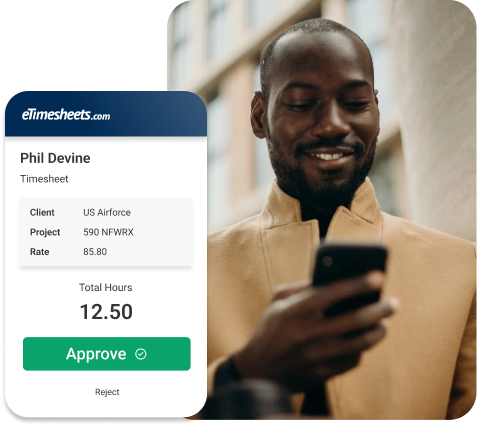
Supervisors approve timesheets from any device in eTimesheets.com.
eTimesheets.com has provided DCAA-compliant timekeeping for small government contractors since 1999, for $10 per user per month.
Nonprofits that receive federal awards follow Uniform Guidance (2 CFR 200) rather than DCAA rules, but the requirement is similar: time-and-effort records must reflect the work actually performed. The same daily entry, approval, and change-tracking controls help organizations pass a Single Audit.
No. DCAA does not certify any software. It audits your practices and internal controls. Software helps you enforce those practices consistently, but your written policy and how your team follows it still matter.
Audit findings can delay contract awards and lead to questioned or disallowed costs. Contractors with significant deficiencies in their business systems can also have payments withheld until the issues are fixed.
A visit where an auditor interviews employees about their current work and compares the answers with their timesheets and charge codes. It tests whether time is recorded daily and charged to the right contract.
$10 per active user per month, with no contract. You can start a free trial with no credit card required.
What makes a timesheet DCAA compliant? A 10-point checklist
eTimesheets.com vs Hour Timesheet: DCAA timekeeping compared
eTimesheets.com has provided DCAA-compliant timekeeping for small government contractors since 1999, for $10 per user per month. Start a free trial with no credit card required.
Start your free trial